Enova International (ENVA)·Q4 2025 Earnings Summary
Enova Q4 2025: EPS Beats by 14% as SMB Lending Surges, Grasshopper Acquisition Advances
January 27, 2026 · by Fintool AI Agent
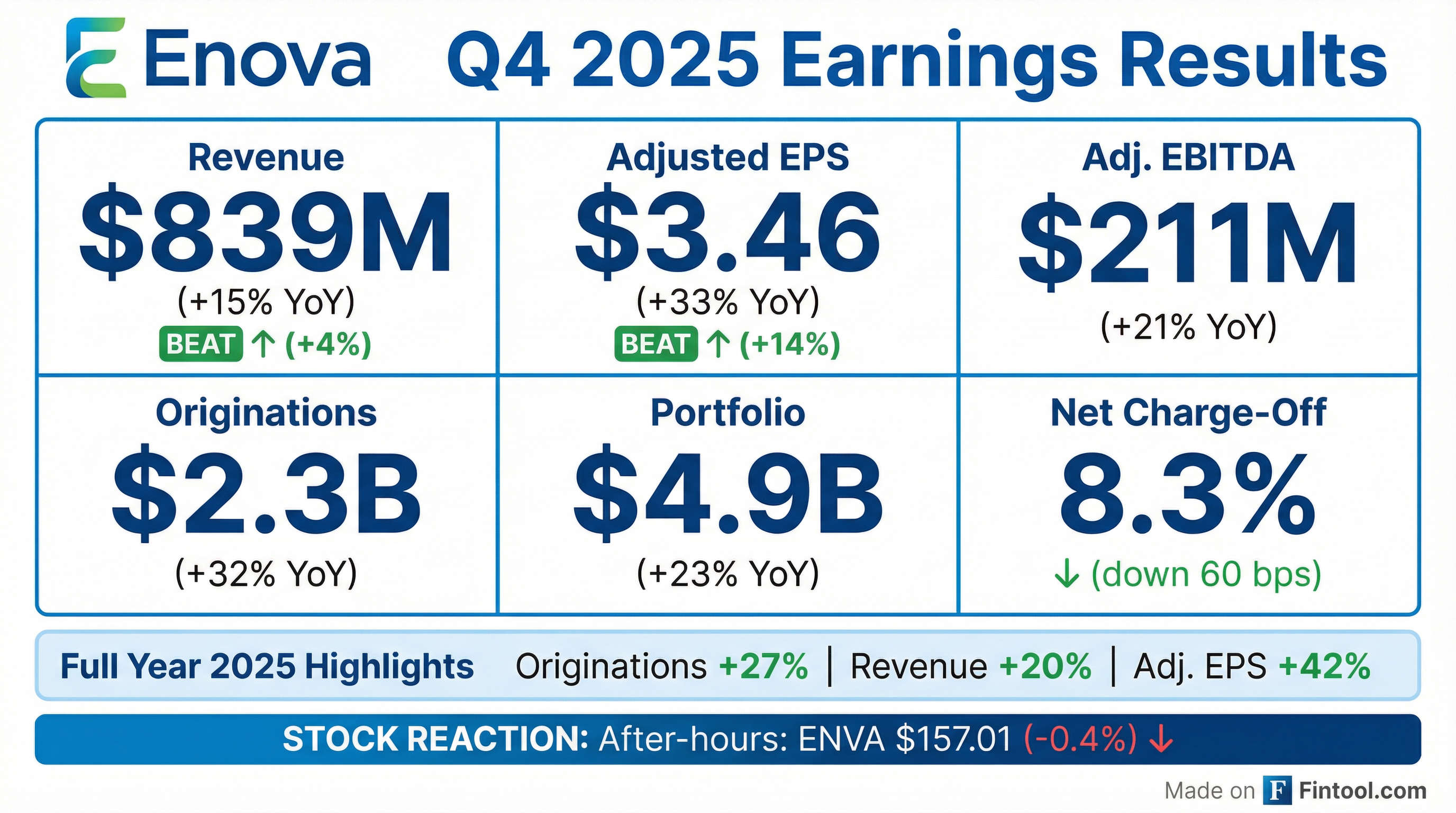
Enova International delivered a strong Q4 2025, beating consensus estimates on both EPS and revenue. Adjusted EPS of $3.46 exceeded the Street's $3.03 estimate by 14%, driven by robust small business originations growth and operating leverage. Revenue of $839 million came in 4% above consensus, marking another record quarter for the consumer finance company.
The quarter capped a record year for Enova: full-year 2025 originations grew 27%, revenue increased nearly 20%, and adjusted EPS surged 42%—the second consecutive year of 30%+ EPS growth.
Did Enova Beat Earnings?
Yes, Enova beat on both metrics:
Q4 2025 marked Enova's eighth consecutive quarter of beating EPS expectations. The company has consistently executed on its "balanced growth strategy," leveraging its diversified product mix and disciplined unit economics approach.
 Ask Fintool AI Agent
What Were the Key Drivers?
Small Business: The Growth Engine
Small business lending continued its exceptional performance with record originations:
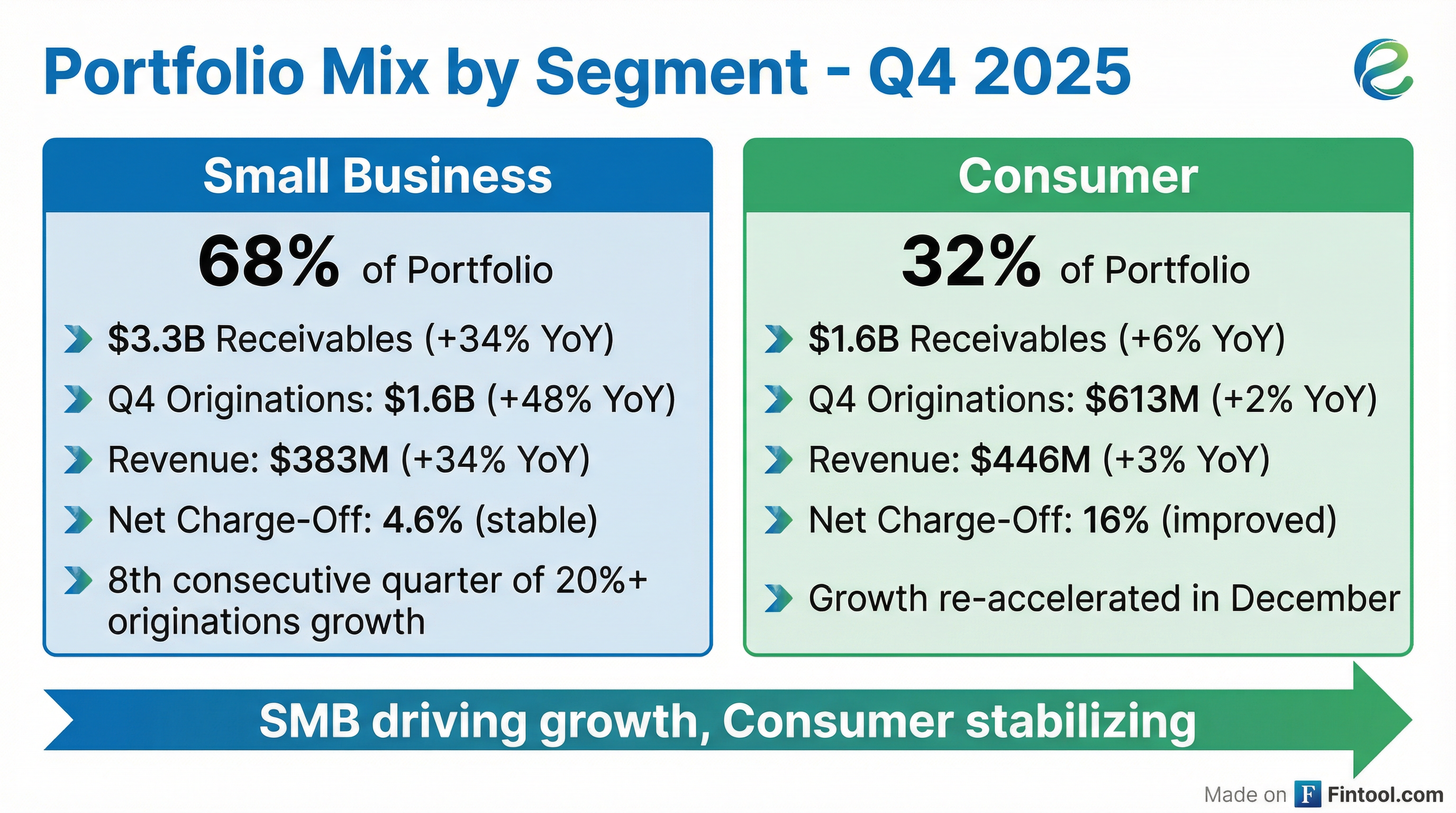
- Q4 Originations: $1.6 billion (+48% YoY, +20% sequentially)
- Revenue: $383 million (+34% YoY)
- Portfolio: $3.3 billion at quarter-end (+34% YoY)
- Net Charge-Off Ratio: 4.6%, stable for 2+ years
This was the eighth consecutive quarter of 20%+ YoY originations growth in SMB. Management highlighted that small business optimism is at all-time highs, with 94% projecting growth over the next 12 months according to their proprietary Cash Flow Trend Report.
Consumer: Re-Acceleration in December
The consumer business showed signs of stabilization after a deliberate pullback earlier in the year:
- Q4 Originations: $613 million (+2% YoY)
- Revenue: $446 million (+3% YoY)
- Net Charge-Off Ratio: 16%, improved both sequentially and YoY
CEO Steve Cunningham noted that consumer originations "accelerated as we moved through the fourth quarter," with December being "exceptionally strong" for the second consecutive year.
What Did Management Guide?
Full Year 2026 Outlook
CFO Scott Cornelis provided the following guidance (excluding Grasshopper contribution):
Q1 2026 Expectations
The guidance assumes a stable macroeconomic environment with no material changes in employment or interest rates.
Ask Fintool AI AgentThe Grasshopper Bank Acquisition: A Transformational Deal
The pending acquisition of Grasshopper Bank remains the key strategic catalyst for 2026. Management provided several updates:
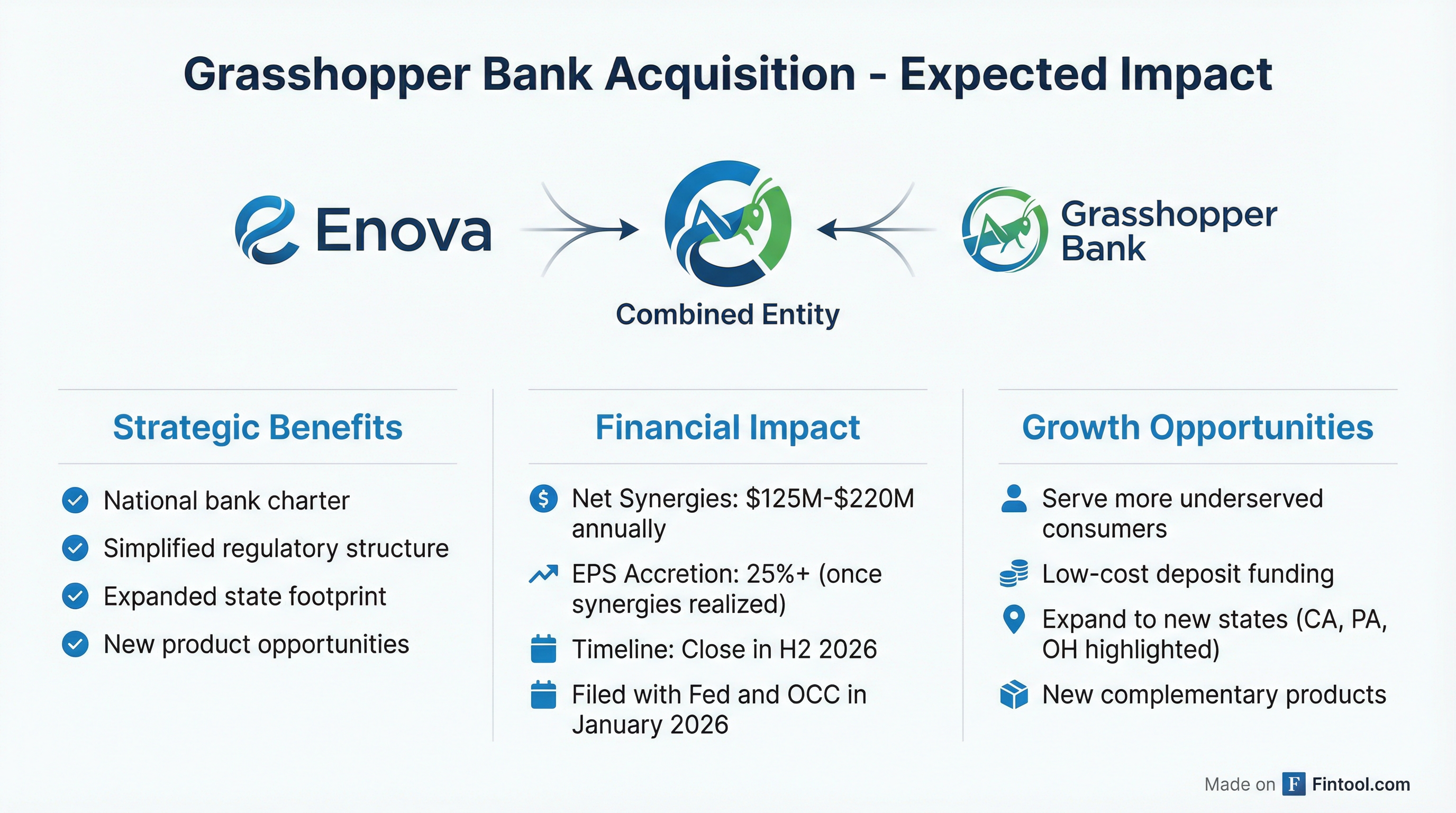
- Regulatory Progress: Applications filed with Federal Reserve and OCC in January 2026
- Expected Close: Second half of 2026
- Net Synergies: $125-220 million annually within 2 years post-close
- EPS Accretion: 25%+ once synergies are fully realized
Strategic Benefits
CEO Steve Cunningham outlined the key advantages of the national bank charter:
- Expanded Geographic Reach: Ability to serve more consumers in states like California, Pennsylvania, and Ohio
- Simplified Regulatory Structure: Consolidation under national bank charter
- Lower-Cost Funding: Access to deposit-gathering capabilities
- New Product Opportunities: Platform for complementary products
How Did the Stock React?
The stock closed at $157.70 on January 27, down 0.4% in regular trading. In after-hours trading following the earnings release, shares were relatively flat at $157.01 (-0.4%).
Year-to-Date Performance
- Current Price: $157.70
- 52-Week High: $168.68
- 52-Week Low: $79.41
- 50-Day Average: $148.20
- 200-Day Average: $117.80
The stock has more than doubled from its 52-week low, reflecting strong fundamentals and enthusiasm around the Grasshopper acquisition. Management noted they "believe there remains additional upside given our track record of consistent growth and earnings."
What Changed From Last Quarter?
The key changes this quarter:
- Marketing Spend Increased: Management "leaned into marketing" during Q4 given strong demand with attractive unit economics
- Consumer Reaccelerated: December consumer originations were "exceptionally strong"
- Credit Improved: Net charge-off ratio declined both sequentially and YoY
Key Management Quotes
"2025 was our second consecutive year of Adjusted EPS growth in excess of 30%, demonstrating the resiliency of our balanced growth strategy." — Steve Cunningham, CEO
"By uniting Enova's sophisticated online lending platform with Grasshopper's national charter and deposit-gathering capabilities, we'll be able to expand access to more consumers and small businesses who've been traditionally underserved by banks." — Steve Cunningham, CEO
"Since our announcement, the energy and excitement from the teams for both companies have been tremendous." — Steve Cunningham, CEO
Q&A Highlights
On Consumer Business Momentum
Asked about the consumer growth trajectory, CEO Cunningham explained that December was "exceptionally strong" for the second consecutive year. The company learned from 2024 and was better positioned to capture holiday demand. Early January trends remain positive, though demand typically "falls off fairly quickly" as you move through the quarter.
On Rate Cap Concerns
When asked about potential credit card rate cap legislation, Cunningham noted this would likely be a positive for Enova, as rate caps historically "reduce availability for the very folks who need it the most." Displaced credit card customers could become Enova customers. He emphasized the probability of federal rate caps passing remains "very, very low."
On Capital Allocation Post-Grasshopper
Management expects to maintain similar leverage ratios post-close (~17-18% Tangible Capital Ratio). The priority will be investing in growth opportunities enabled by the new structure, followed by share repurchases, then M&A.
On Tariff/Trade Exposure
The company continues to monitor industries potentially impacted by tariffs (construction, transportation), but credit performance has "held in really well" with no material concerns.
Ask Fintool AI AgentLeadership Transition
Effective January 1, 2026:
Fisher called this the "longest, most challenging, and most rewarding" role of his career, attributing Enova's success to its "extraordinary people and culture."
Risks and Concerns
- Regulatory Uncertainty: Grasshopper acquisition requires Fed and OCC approval; delays possible
- Consumer Credit: While improving, consumer NCO of 16% remains elevated vs. SMB's 4.6%
- Interest Rate Sensitivity: Cost of funds was 8.3% in Q4; higher-for-longer rates pressure margins
- Concentration Risk: SMB now 68% of portfolio; any credit deterioration would disproportionately impact results
- Economic Sensitivity: Guidance assumes stable employment; recession would pressure both demand and credit
Forward Catalysts
The Bottom Line
Enova delivered another strong quarter, beating estimates on both the top and bottom line while maintaining stable credit quality. The small business lending segment continues to drive exceptional growth (+48% YoY originations), while the consumer business shows signs of re-acceleration after a period of deliberate pullback.
The Grasshopper Bank acquisition remains the key catalyst—if approved, it should simplify the regulatory structure, expand geographic reach, lower funding costs, and drive 25%+ EPS accretion once synergies are realized. Management's 2026 guidance of 20%+ EPS growth (excluding Grasshopper) suggests continued momentum even without deal benefits.
With the stock near all-time highs but management signaling "additional upside," the key debate will be whether current valuations fully reflect both the organic growth trajectory and Grasshopper optionality.
Analysis based on Enova Q4 2025 earnings call transcript and company filings.